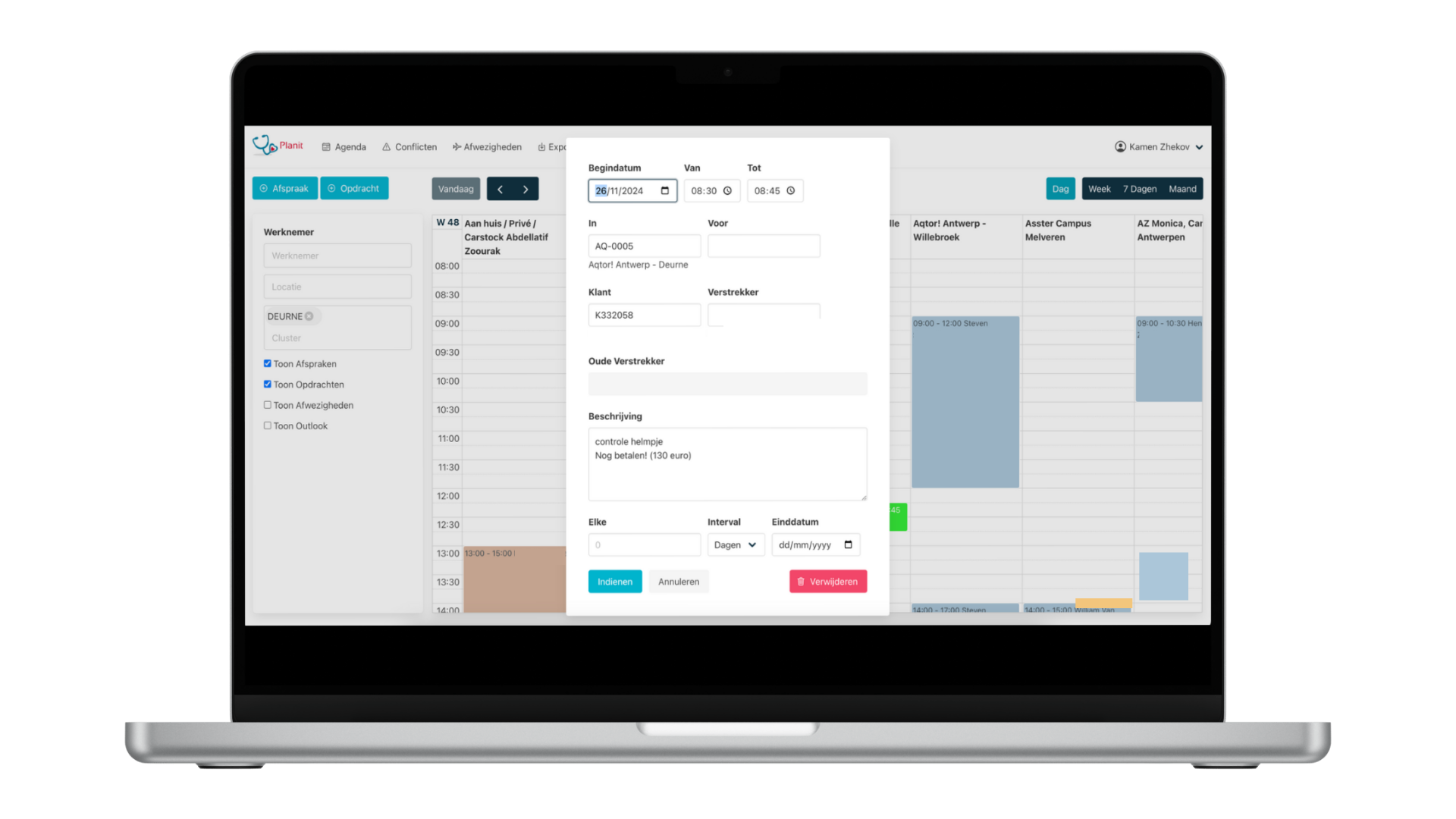
Before the development of the Planit-app, Aqtor! relied on a combination of Excel and Outlook to manage the complex schedules of its providers. This approach was time-consuming and prone to errors, especially as the company keeps growing. "The larger we became, the harder it was to keep everything organized, especially with vacation planning... it was nearly impossible in Excel" says Eva Moens, Coordinator of Business Process Consultancy at Aqtor!.
Aqtor!'s coordinators needed a system that provided clear visibility into the locations and availability of their providers, enabling quick and efficient patient scheduling. "It was difficult to know where a provider was at a given moment and then schedule an appointment", Eva explains. The need for an efficient system became increasingly urgent as Aqtor! expanded, adding more providers and locations.
Python as the ultimate technology choice for Planit
For Planit's development, ACA Group deliberately chose Python and the Django framework. Kamen Zhekov, AI and Python Engineer at ACA Group, explains: "We chose Python and Django because many of the required functionalities are standard. The framework is ideal for complex projects with constraints, database modeling, role-based access control, and user management—all built into Django."
This technology choice was not only efficient but also cost-effective. Django's versatility allowed for smooth integration of complex processes without extensive customization. Moreover, ACA Group's in-house expertise ensured the application was tailored precisely to Aqtor!'s needs.
Another key factor was Python's scalability. As Aqtor!'s scheduling needs grow with the increasing number of providers and locations, Python offers the flexibility to evolve the application accordingly. Strong integration capabilities, such as with their ERP system, enabled ACA to create a smooth, future-proof solution.
.svg?width=174&auto=compress,webp&upscale=true "aca-group (black)")
.svg?width=139&auto=compress,webp&upscale=true "aca-group (black)")