.svg?width=174&auto=compress,webp&upscale=true "aca-group (black)")
.svg?width=139&auto=compress,webp&upscale=true "aca-group (black)")


Reading time 6 min
Stijn Schutyser
Staying current with the latest trends and best practices is crucial in the rapidly evolving world of software development. Innovative approaches like EventSourcing and CQRS can enable developers to build flexible, scalable, and secure systems. At Domain-Driven Design (DDD) Europe 2022, Paolo Banfi delivered an enlightening talk on these two techniques.
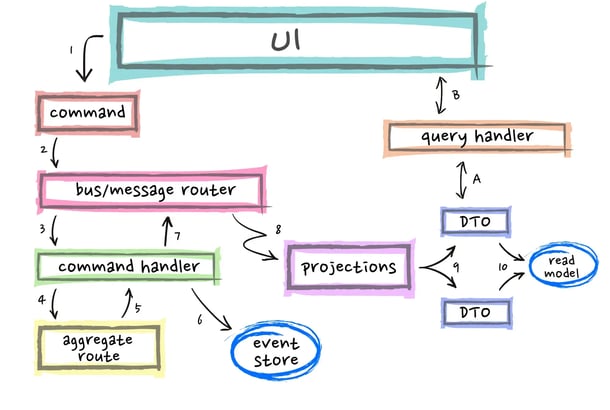
EventSourcing is an innovative approach to data storage that prioritises the historical context of an object. Rather than just capturing the present state of an object, EventSourcing stores all the events that led to that state.
Creating a well-designed event model is critical when implementing EventSourcing. The event model defines the events that will be stored and how they will be structured. Careful planning of the event model is crucial because it affects the ease of data analysis. Modifying the event model after implementation can be tough, so it's important to get it right from the beginning.
CQRS (Command Query Responsibility Segregation) is a technique that separates read and write operations in a system to improve efficiency and understandability. In a traditional architecture, an application typically interacts with a database using a single interface. However, CQRS separates the read and write operations, each of which is handled by different components.
One of the advantages of combining EventSourcing and CQRS is that it facilitates change tracking and data auditing. By keeping track of all the events that led to a particular state, it's easier to track changes over time. This can be particularly useful for applications that require auditing or regulation.
Moreover, separating read and write operations in this way provides several benefits. Firstly, it optimises the system by reducing contention and improving scalability. Secondly, it simplifies the system by isolating the concerns of each side. Finally, it enhances the security of sensitive data by limiting access to the write side of the system.
Another significant advantage of implementing CQRS is the elimination of the need to traverse the entire event stream to determine the current state. By separating read and write operations, the read side of the system can maintain dedicated models optimised for querying and retrieving specific data views. As a result, when querying the system for the latest state, there is no longer a requirement to traverse the entire event stream. Instead, the optimised read models can efficiently provide the necessary data, leading to improved performance and reduced latency.
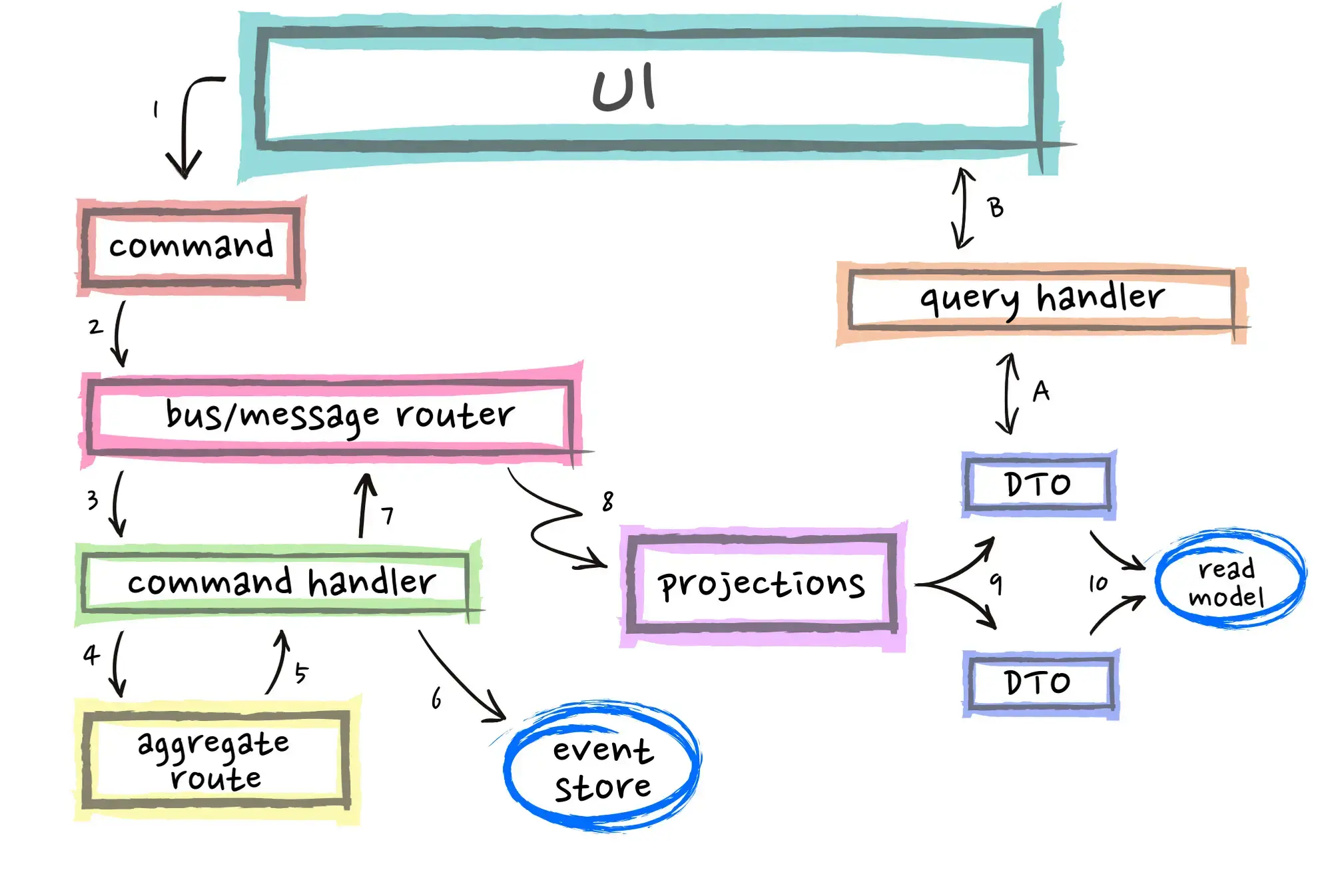
It's important to note that EventSourcing and CQRS may not be suitable for every project. Implementing EventSourcing and CQRS can require more work upfront compared to traditional approaches. Developers need to invest time in understanding and implementing these approaches effectively. However, for systems that demand high scalability, flexibility or security, EventSourcing and CQRS can provide an excellent solution.
Deciding whether to use CQRS or EventSourcing for your application depends on various factors, such as the complexity of your domain model, the scalability requirements, and the need for a comprehensive audit trail of system events.
Developers must evaluate the specific needs of their project before deciding whether to use these approaches.
The combination of EventSourcing and CQRS can provide developers with significant benefits, such as increased flexibility, scalability and security. They offer a fresh approach to software development that can help developers create applications that are more in line with the needs of modern organisations.
If you're interested in learning more about EventSourcing and CQRS, there are plenty of excellent resources available online. Conferences and talks like DDD Europe are also excellent opportunities to stay up-to-date on the latest trends and best practices in software development. Make sure not to miss out on these opportunities if you want to stay ahead of the game!
The next edition of Domain-Driven Design Europe will take place in Amsterdam from the 5th to the 9th of June 2023.
Did you know that ACA Group is one of the proud sponsors of DDD Europe?


In today's digital world, it's crucial to offer a smooth and personalized experience to your customers, no matter which channel they use to communicate with you. For this, Digital Experience Platforms (DXPs) are the solution. DXPs act as a central hu
Read more

Has your company already settled into the seats of first class, or have you not yet found your place on the AI train? Our AI expert Alexander Frimout explains which processes are ideally suited for your first AI business case. And why some companies
Read moreGet in touch with our experts today. They are happy to help!

Get in touch with our experts today. They are happy to help!
Get in touch with our experts today. They are happy to help!
Get in touch with our experts today. They are happy to help!