.png)

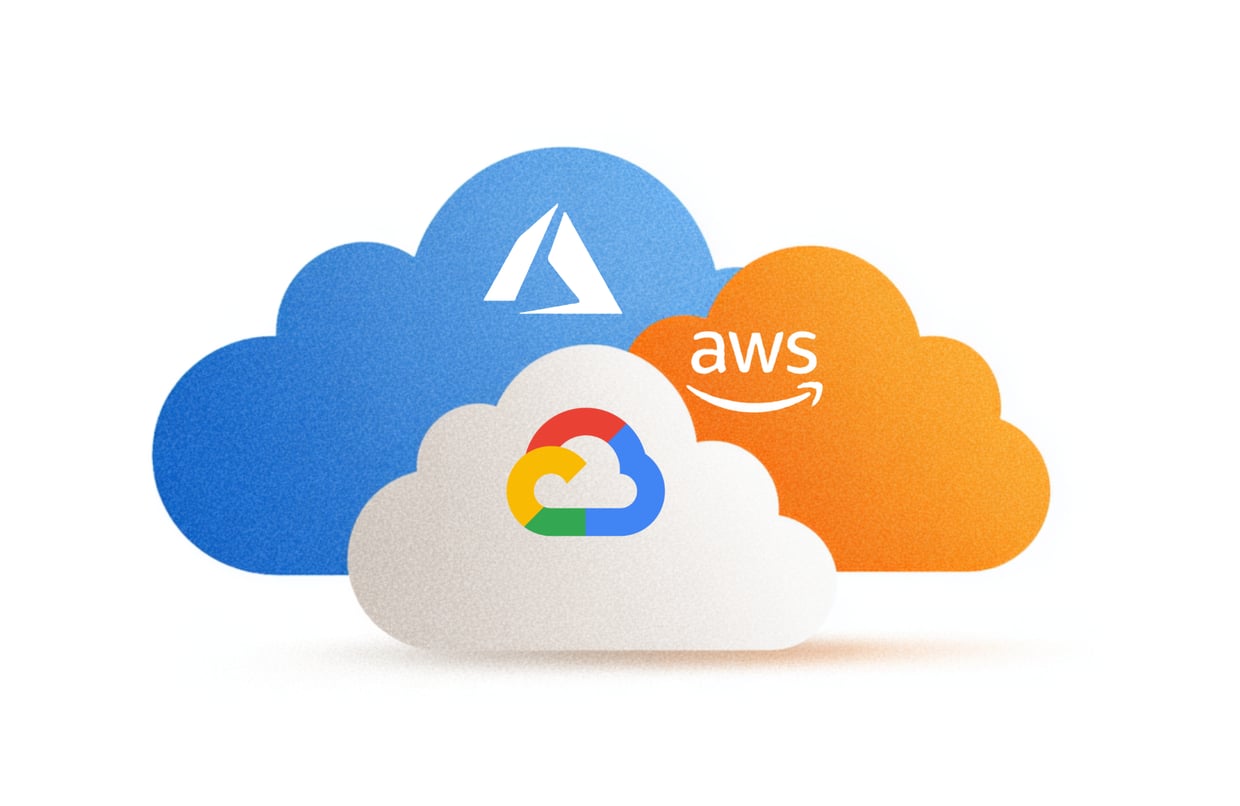
Anyone who has had to manage multiple Azure accounts in the past knows that it is often a hassle. For example, you have to log in to each Azure tenant separately with the correct login details. There is no question of a central management and setting up individual environments manually is very difficult. Implementing consistent access control and security policies is also nearly impossible. Fortunately, there is a solution: Azure Lighthouse. Find out all about it in this blog.
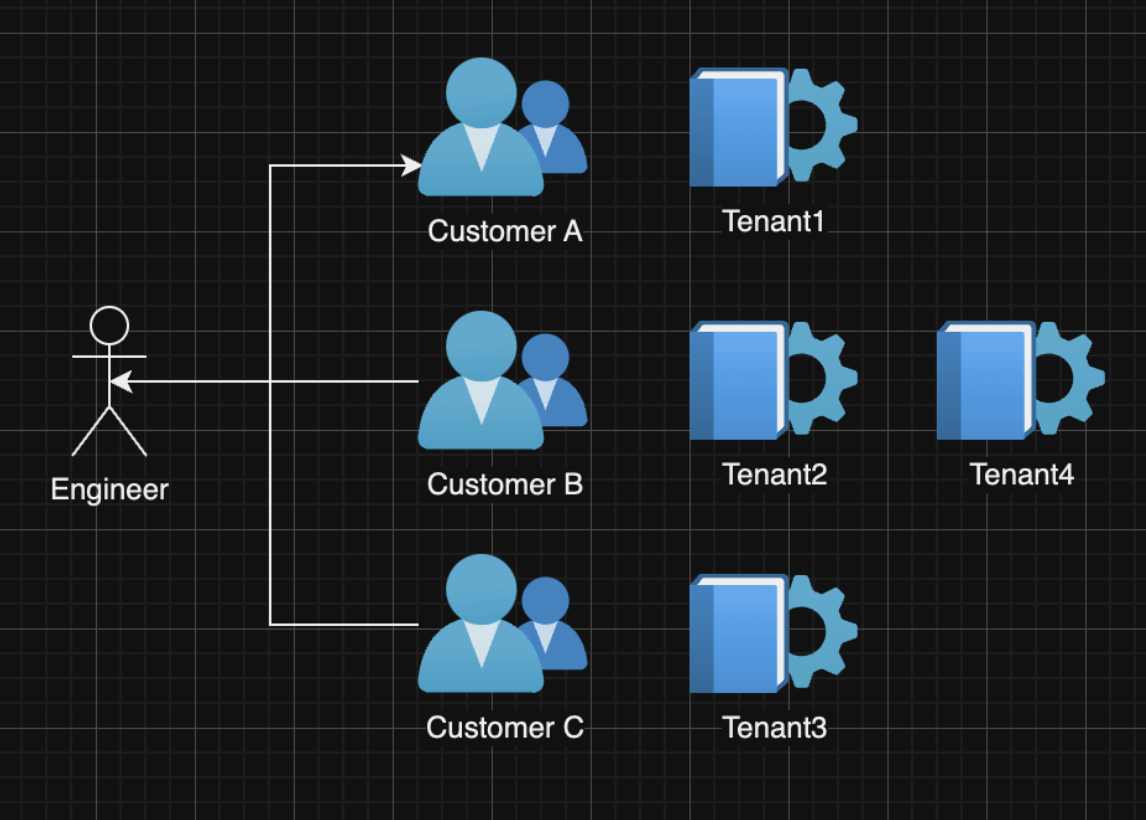
DevOps or system engineers regularly have to work on different Azure tenants and that does not always run smoothly. Some customers want you to use a login from them, other customers prefer to invite you as a guest to manage their environment.
The result is that you often have to switch manually between different Azure tenants. Moreover, it is sometimes necessary to search for the correct login details, which means that valuable time is lost.
Fortunately, now there is Azure Lighthouse with which you can manage the resources within a subscription in an easy and clear way.
What is Azure Lighthouse?
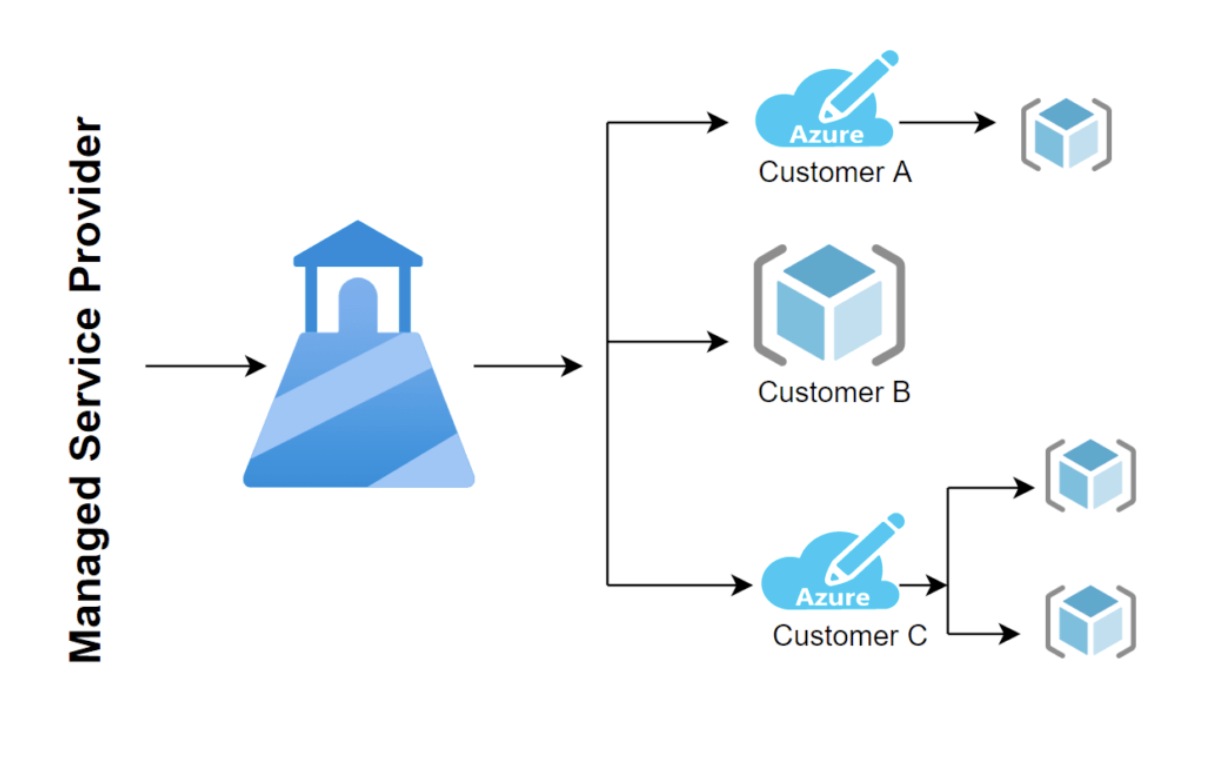
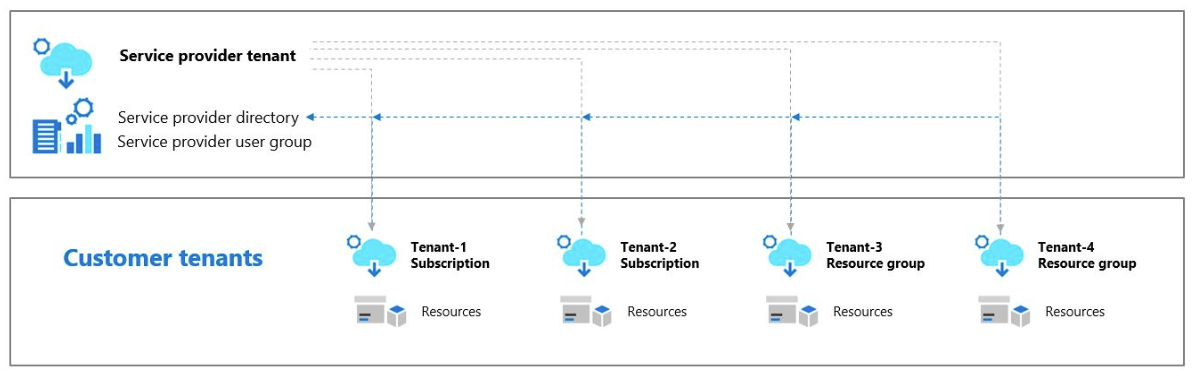
Azure Lighthouse is a Microsoft Azure management service that provides a central platform for managing and monitoring multiple customer environments (tenants) and their resources.
It enables service providers or companies with multiple Azure subscriptions to efficiently manage and control the Azure environments of their customers or subsidiaries. This allows them to streamline operational processes, improve security, and increase overall efficiency by providing a consistent management experience across all managed tenants.
Benefits of Azure Lighthouse
✅ Management of multiple tenants
As a service provider, you can view and manage multiple Azure subscriptions or tenants from a single Azure portal or API endpoint. You can also perform various management tasks, such as deploying and managing resources, applying policies, and monitoring performance, across all managed tenants.
✅ Delegates acces
With Azure Lighthouse, you can grant delegated access to customers or subsidiaries so that they can manage their own Azure resources within defined boundaries. This delegation is based on Azure Role-Based Access Control (RBAC), which provides fine control over privileges and segregation of duties.
✅ Secure multi-tenant environment
Built-in security controls keep each tenant's data and resources isolated and protected. It provides granular access controls, secure multi-factor authentication (MFA), and the ability to apply Azure Policy and Azure Security Center to all managed tenants.
✅ Branding for service providers
Azure Lighthouse allows customizing the Azure portal experience for customers by applying custom branding elements such as logos and themes. This helps maintain a consistent brand identity and improves the overall customer experience.
✅ Integration with Azure Marketplace
As a service provider, you can publish your managed services or solutions on the Azure Marketplace. This allows customers to easily discover and subscribe to these services, further simplifying the relationship between service provider and customer.
How exactly does Azure Lighthouse work?
The Azure accesses are set up per subscription. As a service provider, it is your job to publish an Azure Resource Manager (ARM) template. Templates published via the Azure store can be read by anyone. Would you rather manage just a few customers, or manage a specific customer base? Then there is the option to have the resource templates imported directly to the customer.
This is how you do it:
- Search your tenant for Azure Lighthouse.
- Choose View Service Providers.
- Select View Service Provider Offers.
- Read in the new service offer from here.
Such a resource template contains all kinds of information such as tenant ID of the customer and of the service provider, offer name, description and which role you want to give to the service provider.
Why is Azure Lighthouse interesting for you?
Thanks to Azure Lighthouse, you have less hassle with customer-specific accounts or external invites. Access management is done entirely through your own portal as a service provider. As a result, you no longer have to bother the customer's local IT for access or to send invitations. Everything is centrally arranged. When new colleagues arrive or leave, you can easily remove their accounts from the relevant Azure Active Directory groups, which automatically synchronizes their access to the customer environment. In addition, the customer retains full control over their subscriptions and can unlink the service provider of certain licenses at any time. All the extra hassle that used to be necessary is now gone thanks to Azure Lighthouse. The whole process runs smooth and efficient.
Conclusion
Azure Lighthouse simplifies the management and governance of multiple Azure environments, giving service providers central control, saving them significant management time. In addition, customers can efficiently manage their resources while benefiting from the expertise and services offered by their providers. The increased security is also an extra asset.
For more information, visit the official Microsoft FAQ pages and the official Azure Lighthouse product page.

Questions about Azure Lighthouse?
.png)
What others have also read


In the complex world of modern software development, companies are faced with the challenge of seamlessly integrating diverse applications developed and managed by different teams. An invaluable asset in overcoming this challenge is the Service Mesh. In this blog article, we delve into Istio Service Mesh and explore why investing in a Service Mesh like Istio is a smart move." What is Service Mesh? A service mesh is a software layer responsible for all communication between applications, referred to as services in this context. It introduces new functionalities to manage the interaction between services, such as monitoring, logging, tracing, and traffic control. A service mesh operates independently of the code of each individual service, enabling it to operate across network boundaries and collaborate with various management systems. Thanks to a service mesh, developers can focus on building application features without worrying about the complexity of the underlying communication infrastructure. Istio Service Mesh in Practice Consider managing a large cluster that runs multiple applications developed and maintained by different teams, each with diverse dependencies like ElasticSearch or Kafka. Over time, this results in a complex ecosystem of applications and containers, overseen by various teams. The environment becomes so intricate that administrators find it increasingly difficult to maintain a clear overview. This leads to a series of pertinent questions: What is the architecture like? Which applications interact with each other? How is the traffic managed? Moreover, there are specific challenges that must be addressed for each individual application: Handling login processes Implementing robust security measures Managing network traffic directed towards the application ... A Service Mesh, such as Istio, offers a solution to these challenges. Istio acts as a proxy between the various applications (services) in the cluster, with each request passing through a component of Istio. How Does Istio Service Mesh Work? Istio introduces a sidecar proxy for each service in the microservices ecosystem. This sidecar proxy manages all incoming and outgoing traffic for the service. Additionally, Istio adds components that handle the incoming and outgoing traffic of the cluster. Istio's control plane enables you to define policies for traffic management, security, and monitoring, which are then applied to the added components. For a deeper understanding of Istio Service Mesh functionality, our blog article, "Installing Istio Service Mesh: A Comprehensive Step-by-Step Guide" , provides a detailed, step-by-step explanation of the installation and utilization of Istio. Why Istio Service Mesh? Traffic Management: Istio enables detailed traffic management, allowing developers to easily route, distribute, and control traffic between different versions of their services. Security: Istio provides a robust security layer with features such as traffic encryption using its own certificates, Role-Based Access Control (RBAC), and capabilities for implementing authentication and authorization policies. Observability: Through built-in instrumentation, Istio offers deep observability with tools for monitoring, logging, and distributed tracing. This allows IT teams to analyze the performance of services and quickly detect issues. Simplified Communication: Istio removes the complexity of service communication from application developers, allowing them to focus on building application features. Is Istio Suitable for Your Setup? While the benefits are clear, it is essential to consider whether the additional complexity of Istio aligns with your specific setup. Firstly, a sidecar container is required for each deployed service, potentially leading to undesired memory and CPU overhead. Additionally, your team may lack the specialized knowledge required for Istio. If you are considering the adoption of Istio Service Mesh, seek guidance from specialists with expertise. Feel free to ask our experts for assistance. More Information about Istio Istio Service Mesh is a technological game-changer for IT professionals aiming for advanced control, security, and observability in their microservices architecture. Istio simplifies and secures communication between services, allowing IT teams to focus on building reliable and scalable applications. Need quick answers to all your questions about Istio Service Mesh? Contact our experts
Read more

Liferay DXP has become a widely adopted portal platform for building and managing advanced digital experiences over recent years. Organizations use it for intranets, customer portals, self-service platforms, and more. While Liferay DXP is known for its user-friendliness, its default search functionality can be further optimized to meet modern user expectations. To address this, ACA developed an advanced solution that significantly enhances Liferay’s standard search capabilities. Learn all about it in this blog. Searching in Liferay: not always efficient Traditionally, organizational searches relied on individual keywords . For example, intranet users would search terms like "leave" or "reimbursement" to find the information they needed. This often resulted in an overload of results and documents , leaving users to sift through them manually to find relevant information—a time-consuming and inefficient process that hampers the user experience. The way users search had changed The rise of AI tools like ChatGPT has transformed how people search for information. This is also visible in online search engines like Google, where users increasingly phrase their queries as complete questions. For example: “How do I apply for leave?” or “What travel reimbursement am I entitled to?” To meet these evolving search needs, search functionality must not only be fast but also capable of understanding natural language. Unfortunately, Liferay’s standard search falls short in this area. ACA develops advanced AI-powered search for Liferay To accommodate today’s search behavior, ACA has created an advanced solution for Liferay DXP 7.4 installations: Liferay AI Search . Leveraging the GPT-4o language model , we’ve succeeded in significantly improving Liferay’s standard search capabilities. GPT-4o is a state-of-the-art language model trained on an extensive dataset of textual information. By integrating GPT-4o into our solution, we’ve customized search algorithms to handle more complex queries , including natural language questions. How does Liferay AI Search work? Closed dataset The AI model only accesses data from within the closed Liferay environment. This ensures that only relevant documents— such as those from the Library and Media Library—are accessible to the model. Administrators controls Administrators can decide which content is included in the GPT-4o dataset, allowing them to further optimize the accuracy and relevance of search results. Depending on the user’s profile, the answers and search results are tailored to the information they are authorized to access. Direct answers Thanks to GPT-4o integration, the search functionality provides not only traditional results but also direct answers to user queries. This eliminates the need for users to dig through search results to find the specific information they need. The comparison below illustrates the difference between search results from Liferay DXP’s standard search and the enhanced results from ACA’s Liferay AI Search. Want to see Liferay AI Search in action? Check out the demo below or via this link! Be nefits of Liferay AI Search Whether you use Liferay DXP for your customer platform or intranet, Liferay AI Search offers numerous advantages for your organization: Increased user satisfaction: Users can quickly find precise answers to their queries. Improved productivity: Less time is spent searching for information. Enhanced knowledge sharing: Important information is easier to locate and share. Conclusion With Liferay AI Search, ACA elevates Liferay DXP’s search functionality to meet modern user expectations. By integrating GPT-4o into Liferay DXP 7.4, this solution delivers not only traditional search results but also direct, relevant answers to complex, natural language queries. This leads to a faster, more user-friendly, and efficient search experience that significantly boosts both productivity and user satisfaction. Ready to optimize your Liferay platform search functionality Contact us today!
Read more

Staying current with the latest trends and best practices is crucial in the rapidly evolving world of software development. Innovative approaches like EventSourcing and CQRS can enable developers to build flexible, scalable, and secure systems. At Domain-Driven Design (DDD) Europe 2022 , Paolo Banfi delivered an enlightening talk on these two techniques. What is EventSourcing? EventSourcing is an innovative approach to data storage that prioritises the historical context of an object. Rather than just capturing the present state of an object, EventSourcing stores all the events that led to that state. Creating a well-designed event model is critical when implementing EventSourcing. The event model defines the events that will be stored and how they will be structured. Careful planning of the event model is crucial because it affects the ease of data analysis. Modifying the event model after implementation can be tough, so it's important to get it right from the beginning. What is CQRS CQRS (Command Query Responsibility Segregation) is a technique that separates read and write operations in a system to improve efficiency and understandability. In a traditional architecture, an application typically interacts with a database using a single interface. However, CQRS separates the read and write operations, each of which is handled by different components. Combining EventSourcing and CQRS One of the advantages of combining EventSourcing and CQRS is that it facilitates change tracking and data auditing. By keeping track of all the events that led to a particular state, it's easier to track changes over time. This can be particularly useful for applications that require auditing or regulation. Moreover, separating read and write operations in this way provides several benefits. Firstly, it optimises the system by reducing contention and improving scalability. Secondly, it simplifies the system by isolating the concerns of each side. Finally, it enhances the security of sensitive data by limiting access to the write side of the system. Another significant advantage of implementing CQRS is the elimination of the need to traverse the entire event stream to determine the current state. By separating read and write operations, the read side of the system can maintain dedicated models optimised for querying and retrieving specific data views. As a result, when querying the system for the latest state, there is no longer a requirement to traverse the entire event stream. Instead, the optimised read models can efficiently provide the necessary data, leading to improved performance and reduced latency. When to use EventSourcind and CQRS It's important to note that EventSourcing and CQRS may not be suitable for every project. Implementing EventSourcing and CQRS can require more work upfront compared to traditional approaches. Developers need to invest time in understanding and implementing these approaches effectively. However, for systems that demand high scalability, flexibility or security, EventSourcing and CQRS can provide an excellent solution. Deciding whether to use CQRS or EventSourcing for your application depends on various factors, such as the complexity of your domain model, the scalability requirements, and the need for a comprehensive audit trail of system events. Developers must evaluate the specific needs of their project before deciding whether to use these approaches. CQRS is particularly useful for applications with complex domain models that require different data views for different use cases. By separating the read and write operations into distinct models, you can optimise the read operations for performance and scalability, while still maintaining a single source of truth for the data. Event Sourcing is ideal when you need to maintain a complete and accurate record of all changes to your system over time. By capturing every event as it occurs and storing it in an append-only log, you can create an immutable audit trail that can be used for debugging, compliance, and other purposes. Conclusion The combination of EventSourcing and CQRS can provide developers with significant benefits, such as increased flexibility, scalability and security. They offer a fresh approach to software development that can help developers create applications that are more in line with the needs of modern organisations. If you're interested in learning more about EventSourcing and CQRS, there are plenty of excellent resources available online. Conferences and talks like DDD Europe are also excellent opportunities to stay up-to-date on the latest trends and best practices in software development. Make sure not to miss out on these opportunities if you want to stay ahead of the game! The next edition of Domain-Driven Design Europe will take place in Amsterdam from the 5th to the 9th of June 2023. Did you know that ACA Group is one of the proud sponsors of DDD Europe? {% module_block module "widget_bc90125a-7f60-4a63-bddb-c60cc6f4ee41" %}{% module_attribute "buttons" is_json="true" %}{% raw %}[{"appearance":{"link_color":"light","primary_color":"primary","secondary_color":"primary","tertiary_color":"light","tertiary_icon_accent_color":"dark","tertiary_text_color":"dark","variant":"primary"},"content":{"arrow":"right","icon":{"alt":null,"height":null,"loading":"disabled","size_type":null,"src":"","width":null},"tertiary_icon":{"alt":null,"height":null,"loading":"disabled","size_type":null,"src":"","width":null},"text":"More about ACA Group"},"target":{"link":{"no_follow":false,"open_in_new_tab":false,"rel":"","sponsored":false,"url":{"content_id":null,"href":"https://acagroup.be/en/aca-as-a-company/","href_with_scheme":"https://acagroup.be/en/aca-as-a-company/","type":"EXTERNAL"},"user_generated_content":false}},"type":"normal"}]{% endraw %}{% end_module_attribute %}{% module_attribute "child_css" is_json="true" %}{% raw %}{}{% endraw %}{% end_module_attribute %}{% module_attribute "css" is_json="true" %}{% raw %}{}{% endraw %}{% end_module_attribute %}{% module_attribute "definition_id" is_json="true" %}{% raw %}null{% endraw %}{% end_module_attribute %}{% module_attribute "field_types" is_json="true" %}{% raw %}{"buttons":"group","styles":"group"}{% endraw %}{% end_module_attribute %}{% module_attribute "isJsModule" is_json="true" %}{% raw %}true{% endraw %}{% end_module_attribute %}{% module_attribute "label" is_json="true" %}{% raw %}null{% endraw %}{% end_module_attribute %}{% module_attribute "module_id" is_json="true" %}{% raw %}201493994716{% endraw %}{% end_module_attribute %}{% module_attribute "path" is_json="true" %}{% raw %}"@projects/aca-group-project/aca-group-app/components/modules/ButtonGroup"{% endraw %}{% end_module_attribute %}{% module_attribute "schema_version" is_json="true" %}{% raw %}2{% endraw %}{% end_module_attribute %}{% module_attribute "smart_objects" is_json="true" %}{% raw %}null{% endraw %}{% end_module_attribute %}{% module_attribute "smart_type" is_json="true" %}{% raw %}"NOT_SMART"{% endraw %}{% end_module_attribute %}{% module_attribute "tag" is_json="true" %}{% raw %}"module"{% endraw %}{% end_module_attribute %}{% module_attribute "type" is_json="true" %}{% raw %}"module"{% endraw %}{% end_module_attribute %}{% module_attribute "wrap_field_tag" is_json="true" %}{% raw %}"div"{% endraw %}{% end_module_attribute %}{% end_module_block %}
Read moreWant to dive deeper into this topic?
Get in touch with our experts today. They are happy to help!

Want to dive deeper into this topic?
Get in touch with our experts today. They are happy to help!

Want to dive deeper into this topic?
Get in touch with our experts today. They are happy to help!

Want to dive deeper into this topic?
Get in touch with our experts today. They are happy to help!