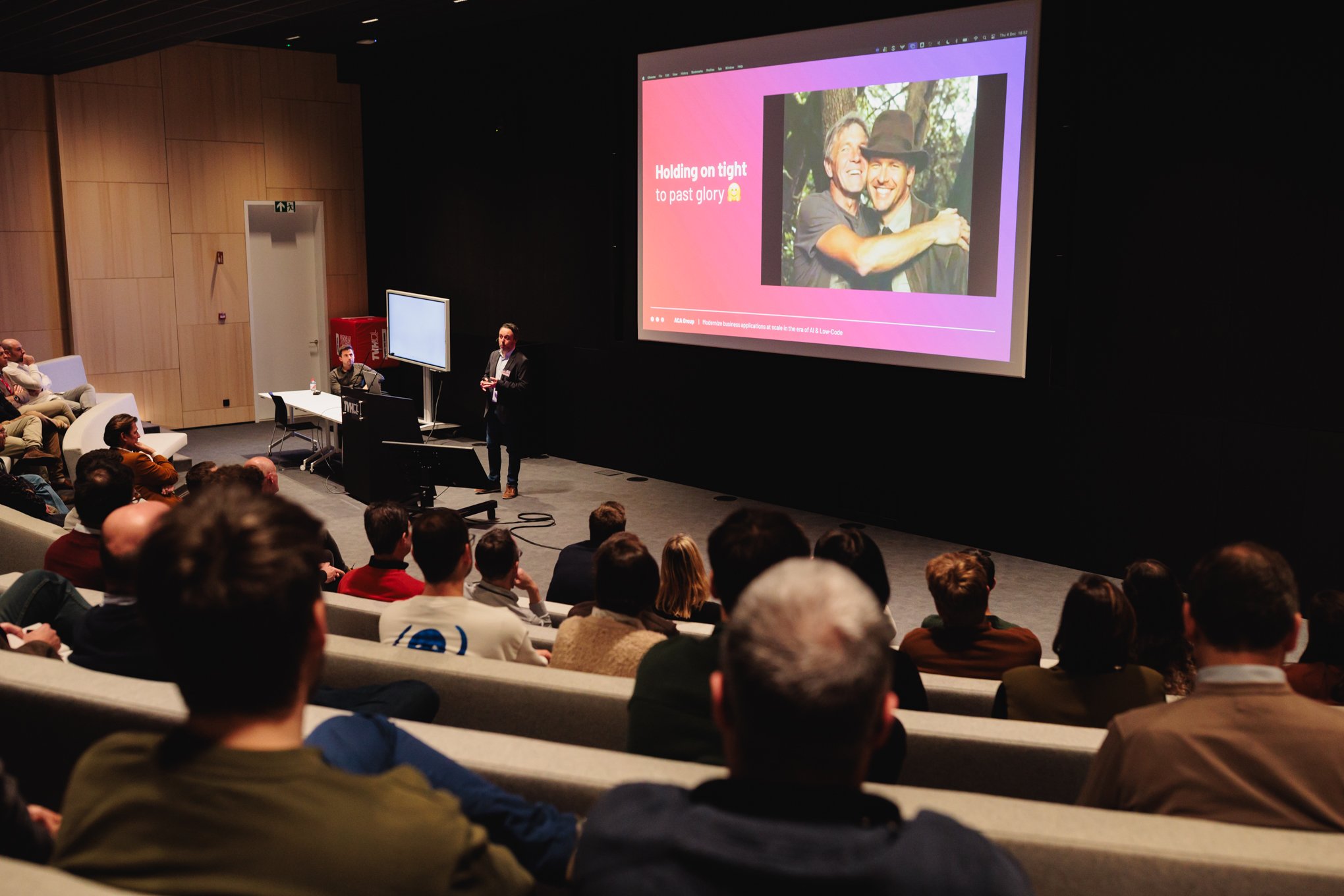
At the TVH IT Talks 205, Greg Van Dorpe (Low-Code Offering Lead) shared ACA’s view on the current IT landscape with a room of engaged participants. He highlighted the realities many teams recognise: growing expectations, talent shortages and the struggle to balance innovation with keeping existing systems running. It sparked a broader conversation about how organizations can modernize more sustainably.
Why evolving the application landscape matters
Across industries, organizations rely on systems that have grown organically over many years. While these systems provide stability, they can slow down innovation when changes are difficult or expensive to implement. Traditional custom development remains essential for big, complex and mission-critical applications, but it is not always the most efficient approach for every type of solution.
SaaS platforms offer speed and out-of-the-box capabilities, although they can introduce limitations or high customization costs. The challenge is finding the right balance.
Our approach: choosing the right technology for the right need
At ACA, we don’t see Low-Code as a replacement for custom development. Instead, we combine both approaches to fit the problem at hand:
- Custom development for deep engineering, complex logic, unique business capabilities and high-differentiation use cases.
- Low-Code for accelerating delivery, standardizing and uniformising development practices, modernizing legacy systems, and supporting high-volume or fast-changing business processes.
This combination gives organizations the flexibility to innovate where it matters, while keeping long-term cost and complexity under control.
Low-Code as a strategic accelerator
Enterprise-grade Low-Code platforms enable teams to:
- deliver applications 2 to 5 times faster
- reduce total cost of ownership
- collaborate more effectively with the business
- bring consistency and maintainability to the landscape
In our projects, Low-Code is particularly valuable for:
- legacy & application landscape evolution
- digital customer and employee experiences
- AI adoption in a controlled and practical way
- extending core systems without creating fragile and costly customizations
The principle is simple: keep the core stable and clean, innovate at the edge, and use engineering effort where it has the most impact.

AI-first: from CoPilots to Agentic AI
AI plays an increasingly important role in modern software development. Greg highlighted how GenAI can help analyse legacy systems, support documentation and accelerate development. According to Gartner, by 2027 GenAI tools will be used to explain legacy business applications and generate appropriate replacements, potentially reducing modernization costs by up to 70%.
The rise of AI Copilots is quite overwhelming this year. So what is the real value they currently bring?
A Gartner report from 2025 shows that AI Co-Pilots deliver a productivity boost (5-20%) but introduce new risks due to still being "uncontrollable & unpredictable. Introducing a new level of complexity in maintaining a cohesive and manageable code base when developing with more than one developer on a project.
A key topic in the session was Agentic AI, autonomous AI agents capable of performing tasks or making decisions. While the technology is promising, most pilot projects still face challenges around reliability, orchestration and governance.
According to an MIT report from mid 2025, 95% of agentic AI pilot projects fail to reach production or show measurable ROI. Meanwhile, the 5% that make it are making millions.
At ACA, we take a practical approach:

- focus on specialised agents, not general-purpose “do-everything” agents
- keep humans in the loop
- ensure strong governance and data management
- align AI adoption with real business value
The real power lies in the combination of AI and Low-Code

The biggest impact happens where Low-Code and AI strengthen each other. Greg demonstrated how OutSystems, as an AI-first development platform, acts as a true Swiss army knife for IT teams thanks to:
- AI-driven app generation from prompts
- AI-assisted development and quality checks
- Building and orchestrating AI agents with a human in the loop
- Supported by an enterprise-grade full-stack Low-Code development platform
An AI-first & Low-Code approach also requires transformation: real product teams, careful technology choices to avoid lock-in and strong governance to prevent Shadow IT/AI and ensure data security. One conclusion stood out: while these technologies reshape IT, the role of skilled IT and design professionals remains crucial for delivering high-quality and secure solutions.




What others have also read


OutSystems: a catalyst for business innovation In today's fast-paced business landscape, organisations must embrace innovative solutions to stay ahead. There are a lot of strategic technological trends that address crucial business priorities such as digital immunity, composability, AI, platform engineering, Low-Code , and sustainability. OutSystems , the leading Low-Code development platform , has become a game-changer in supporting organisations to implement these trends efficiently and sustainably. OutSystems enhances cyber security As organisations increasingly rely on digital systems, cyber threats pose a significant risk. Additionally, digital engagement with customers, employees, and partners, plays a vital role in a company's well-being. The immunity and resilience of an organisation is now as strong and stable as its core digital systems. Any unavailability can result in a poor user experience, revenue loss, safety issues, and more. OutSystems provides a robust and secure platform that helps build digital immune systems , safeguarding against evolving cybersecurity challenges. With advanced threat detection, continuous monitoring, secure coding practices , and AI code-scanning, OutSystems ensures applications are resilient and protected. Furthermore, the platform covers most of the security aspects for project teams, enabling them to focus on delivering high value to end customers while best practices are recommended by the platform through code analysis using built-in patterns. OutSystems simplifies cloud-native infrastructure management Cloud-native architecture has emerged as a vital component for modern application development. The OutSystems Developer Cloud Platform enables teams to easily create and deploy cloud-native applications, leveraging the scalability and flexibility of cloud infrastructure through Kubernetes . It allows companies to: Optimise resource utilisation Auto-scale application runtimes Reduce operational costs Adopt sustainable practices (serverless computing, auto-scaling, …) All this without the need for prior infrastructure investment nor the deep technical knowledge required to operate it and the typical burdens associated. OutSystems: gateway to AI and automation AI and hyper-automation have become essential business tools for assisting in content creation, virtual assistants, faster coding, document analysis, and more. OutSystems empowers professional developers to be more productive by infusing AI throughout the application lifecycle. Developers benefit from AI-assisted development, natural language queries, and even Generative AI. Once ready with your development, transporting an app to the test or production environment only takes a few clicks. The platform highly automates the process and even performs all the necessary validations and dependency checks to ensure unbreakable deployments. OutSystems seamlessly integrates with AI capabilities from major cloud providers like Amazon, Azure (OpenAI), and Google, allowing project teams to leverage generative AI, machine learning, natural language processing , and computer vision . By making cutting-edge technologies more accessible, OutSystems accelerates digital transformation and creates sustainable competitive advantages. OutSystems enables composable architecture for agility Composable architecture and business apps, characterised by modular components, enable rapid adaptation to changing business needs. OutSystems embraces this trend by providing a cloud-native Low-Code platform using and supporting this type of architecture. It enables teams to easily build composable technical and business components. With the visual modelling approach of Low-Code, a vast library of customizable pre-built components and a micro-service-based application delivery model, OutSystems promotes high reusability and flexibility. This composable approach empowers organisations to: Respond rapidly to changing business needs Experiment with new ideas Create sustainable, scalable, and resilient solutions OutSystems enables the creation of business apps that can be easily integrated, replaced, or extended, supporting companies on their journey towards composability and agility. OutSystems facilitates self-service and close collaboration Platform engineering, which emphasises collaboration between development and operations teams, drives efficiency and scalability. OutSystems provides a centralised Low-Code platform embracing this concept at its core by being continuously extended with new features, tools and accelerators. Furthermore the platform facilitates the entire application development lifecycle until operations . Including features like Version control Automated deployment Continuous integration and delivery (CI/CD) Logging Monitoring Empowering organisations to adopt agile DevOps practices. With OutSystems, cross-functional teams can collaborate seamlessly, enabling faster time-to-market and improved software quality. By supporting platform engineering principles, OutSystems helps organisations achieve sustainable software delivery and operational excellence. OutSystems drives sustainability in IT OutSystems leads the way in driving sustainability in IT through its green IT Low-Code application development platform and strategic initiatives. By enabling energy-efficient development, streamlining application lifecycle management, leveraging a cloud-native infrastructure , and promoting reusability , OutSystems sets an example for the industry. Organisations can develop paperless processes, automate tasks, modernise legacy systems, and simplify IT landscapes using OutSystems 3 to 4 times faster, reducing overall costs and ecological footprint. By embracing OutSystems, companies can align their IT operations with a greener future, contribute to sustainability, and build a more resilient planet. Wrapping it up In the era of digital transformation and sustainability, OutSystems is a powerful ally for organisations, delivering essential business innovations, such as … High-performance Low-Code development Cloud-native architecture AI and automation Robust security measures Collaborative DevOps practices Take the OutSystems journey to align with IT trends, deliver exceptional results, and contribute to a sustainable and resilient future. Eager to start with OutSystems? Let us help
Read more

In this blog, we dive deeper into 'Low-Code' as a concept and how to choose the best Low-Code platform for your business. Low-Code as a concept Low-Code, visual development application modelling, citizen development, … If you are a developer, these terms will definitely ring a bell. But what exactly is Low-Code, why should it matter to you, and who benefits from it? The answer is simple: "It depends". Taking a step back, Low-Code is a concept revolving around visual development or modeling and widely supported by automation . This definition makes it applicable to many different areas in IT and more. How to choose the best Low-Code platform? Just having a quick glimpse at the Forrest and Gartner reports will result in more than 300 different Low-Code platforms and products. Are these all equivalent? Obviously not. Are they all meant for Application Development? Again, no. So how can you determine what Low-Code platform, product or solution might be relevant to you and your customers? Focusing on the leaders and well-known names, we can easily recognise some patterns to categorise them (see the example below). Low-Code solutions by category - Robotic Process Automation (RPA) Using Low-Code and visual development/modeling for process creation, integrations and automation. - Custom software delivery automation Empowering traditional development frameworks with Low-Code accelerators to generate parts of applications or starting points. - Package customisation Most of the leading package vendors are investing in Low-Code solutions within their own platform to facilitate customisations. - Test automation Everyone knows Selenium , a very powerful tool to create and maintain test scripts. Some platforms are even applying a no-code approach to model the test cases and have the Selenium scripts generated, executed and maintained without any need for coding. - Citizen development for team and departmental apps Tired of working with Excel or Google Sheets? Looking for an easy to use and to learn solution to build small and simple applications for your team or department? Then Citizen Development platforms are the solution for you. However, it is not suitable for enterprise applications. So use it for what it's intended. After all, you don't want your gardener assembling your new electric car, do you? - Enterprise full-stack development platforms A Low-Code enterprise development platform provides a Graphical User Interface for programming and generates the underlying code automatically, reducing hand-coding efforts for developers. These tools not only help with quick front-end development, but also with logic, back-end, integrations and even lifecycle management. In with Low-Code development, out with traditional development? Can Low-Code fully replace traditional development such as .Net or Java? Of course not! But Low-Code development platforms can definitely help deliver more projects in less time with the same amount of people . It enables organisations to react faster to opportunities with a shorter time to market. Moreover, it can help make a valid business case for projects that have been waiting in the backlog due to "other priorities" and teams mainly focusing on business critical systems in your company. Why we use Low-Code at ACA Group As an IT-consulting company and integrator, we are focused on delivering custom software to cover the specific needs of our customers. Low-Code offers us a powerful tool to do so. And not only for the simple apps! With the right Low-Code platform you can even modernise your legacy and build customer-facing web and mobile apps integrated with your ERP, CRM, IAM and broad existing landscape. It can also help you rationalise and simplify your IT landscape and bring back your company's tools under IT Governance without having to tell the business "sorry we have other priorities". Our strategic choice: OutSystems ACA chose to make a strategic partnership with OutSystems , a leading and by far the most productive, versatile and stable Low-Code platform on the market for enterprise full-stack development. Our team of experts has been working with OutSystems since 2016 and has also delivered projects with other leading platforms. We are keeping up to date with the latest announcements, new functionalities and major differences between the 3 leading Low-Code platforms for general application development. That way we can advise our customers on the best fit for their needs. OutSystems Developer Cloud: best fit for full-stack development OutSystems Developer Cloud is the leading PaaS cloud native high performance Low-Code platform for full-stack development and integrations. It covers the widest set of use cases. From internal apps, to B2B- and B2C customer-facing web and mobile applications, processes and even core systems. Using it for legacy modernisation and innovation projects is a big accelerator for your digital transformation. The benefits of OutSystems Developer Cloud What does OutSystems Developer Cloud bring to companies and the developers and software engineers using it to deliver the projects? 3-4x times faster delivery One unified way of developing web, mobile, front-end, back-end and integrations Easy to learn for software engineers and web developers AI-assisted development and built-in generative AI No need for additional development tools (GitHub, Eclipse, Visual Studio, …) Development teams focused on delivering value Secure out of the box A lot less maintenance No infrastructure to manage Built-in lifecycle management Auto-scaling All this while still having the architecture and best practices in your hands. Want to get started with Low-Code? {% module_block module "widget_90cf7739-dc28-449d-9a8c-ff948108e163" %}{% module_attribute "buttons" is_json="true" %}{% raw %}[{"appearance":{"link_color":"light","primary_color":"primary","secondary_color":"primary","tertiary_color":"light","tertiary_icon_accent_color":"dark","tertiary_text_color":"dark","variant":"primary"},"content":{"arrow":"right","icon":{"alt":null,"height":null,"loading":"disabled","size_type":null,"src":"","width":null},"tertiary_icon":{"alt":null,"height":null,"loading":"disabled","size_type":null,"src":"","width":null},"text":"Let's do it together"},"target":{"link":{"no_follow":false,"open_in_new_tab":false,"rel":"","sponsored":false,"url":{"content_id":null,"href":"","href_with_scheme":"","type":"CONTENT"},"user_generated_content":false}},"type":"normal"}]{% endraw %}{% end_module_attribute %}{% module_attribute "child_css" is_json="true" %}{% raw %}{}{% endraw %}{% end_module_attribute %}{% module_attribute "css" is_json="true" %}{% raw %}{}{% endraw %}{% end_module_attribute %}{% module_attribute "definition_id" is_json="true" %}{% raw %}null{% endraw %}{% end_module_attribute %}{% module_attribute "field_types" is_json="true" %}{% raw %}{"buttons":"group","styles":"group"}{% endraw %}{% end_module_attribute %}{% module_attribute "isJsModule" is_json="true" %}{% raw %}true{% endraw %}{% end_module_attribute %}{% module_attribute "label" is_json="true" %}{% raw %}null{% endraw %}{% end_module_attribute %}{% module_attribute "module_id" is_json="true" %}{% raw %}201493994716{% endraw %}{% end_module_attribute %}{% module_attribute "path" is_json="true" %}{% raw %}"@projects/aca-group-project/aca-group-app/components/modules/ButtonGroup"{% endraw %}{% end_module_attribute %}{% module_attribute "schema_version" is_json="true" %}{% raw %}2{% endraw %}{% end_module_attribute %}{% module_attribute "smart_objects" is_json="true" %}{% raw %}null{% endraw %}{% end_module_attribute %}{% module_attribute "smart_type" is_json="true" %}{% raw %}"NOT_SMART"{% endraw %}{% end_module_attribute %}{% module_attribute "tag" is_json="true" %}{% raw %}"module"{% endraw %}{% end_module_attribute %}{% module_attribute "type" is_json="true" %}{% raw %}"module"{% endraw %}{% end_module_attribute %}{% module_attribute "wrap_field_tag" is_json="true" %}{% raw %}"div"{% endraw %}{% end_module_attribute %}{% end_module_block %}
Read more

What is Event Storming? Before getting into details, let’s discuss EventStorming’s role in an agile context. Event Storming has become a very popular methodology during the past years and has found its place in the software development lifecycle as a requirements gathering technique. Created by Alberto Brandolini in 2012 as an alternative to precise UML diagramming, Event Storming is a workshop-style technique that brings project stakeholders together (both developers and non-technical users) to explore complex business domains in domain-driven design architecture . One of the strengths of Event Storming is being able to focus on the business stakeholders and the high level of interaction. The technique is straightforward and requires no technical training at all. Using Event Storming, there are different goals you can pursue: identify improvement areas of an existing business flow; explore if a new business model is viable; gain insight into a shared understanding of how a business operates; design clean and maintainable Event-Driven software. There are three primary levels of abstraction for Event Storming: Big picture: used for exploring the current understanding of the system by gathering key people with different backgrounds and creating a shared understanding. Process modelling: in this level, we model a single business process from start to finish, clarifying all the business rules and making sure everyone is aligned. Software design: in this last step, we start designing the software based on building blocks from Domain-Driven Design and a reactive programming paradigm. Each sticky note potentially turns into a software artefact during the implementation phase. When applying Event Storming, you first need to identify the Domain Events in the problem domain on a timeline. The source of a Domain Event could be the following: A user interaction An event coming The result of time passing by The consequence of another Domain Event. We then write this domain event down on an orange sticky note. When all domain events are defined, the second step is to find the command that caused these domain events. Commands are written on blue notes and placed directly before the corresponding domain event. Finally, you’ll need to identify the aggregates within which commands are executed and where events happen are identified. These aggregates are written down on yellow sticky notes. Using the System Modeler In the past years, we have embraced Event Storming as a requirements gathering technique within ACA-IT Solutions – so much so, that it’s now an integrated part of our portfolio and how we develop software for our customers. If you’d like more details about that or want to know more about Event Storming, you can contact us here . The System Modeler uses EventStorming as an inspiration for documenting (modelling) the events that represent business processes, configuring high-level properties associated with those events, then allowing automatic generation of Apps and Collaboration Types from the model. A System Modeler session involves the use of five virtual sticky notes to represent: Event: something that happens in the business Reaction: responses to events Command: user-driven actions that produce events External System: systems that are external to the business Issue: document potential problems or unknowns about events The System Modeler also makes use of one container: Bounded Context: contain notes that share a common vocabulary Below, you can see the result of an EventStorming session in the System Modeler, representing a city’s pothole reporting and tracking system. The model represents: a mobile app that allows city residents to report a pothole creation of new database records to document reported potholes real-time notification of city services of new pothole reports enable workers to update the status of a pothole real-time notification to the reporting resident when the status has changed System Modeler is a great way to bridge the gap between the requirements gathering of an event-driven application and the actual implementation. In this case, we’re doing that electronically on the canvas. Moreover, this is a collaborative environment, allowing several people to work on this model at the same time. Using the System Modeler, users can collaborate with multiple individuals not only in a given room, but across any number of geographic locations. This is an awesome way to genuinely do a sort of distributed requirements gathering session. Even more so with the pandemic still preventing lots of people from going into the office! From requirements to superfast POCs Based on this requirements gathering session, we can now take this requirements model and create an application. All users need to do is switch from ‘model mode’ to ‘generate mode’ and group the various elements. After having defined topics and collaboration tasks, you just click on the Generate button. This simple action alone generates about 70% of this particular application’s code! This makes System Modeler probably the easiest way to very quickly move from application requirements design into application development itself. Conclusion Modern applications need to operate in real-time as they will be driven by what’s happening at that time in the real world. They’ll need to easily incorporate artificial intelligence and IoT technology, and the applications themselves will need to be distributed at the source of the events. The software logic will need to be able to run everywhere (cloud, edge, on-premises). These applications will also require integrating human-beings in the process for when a higher level of intuition and reasoning is needed. With System Modeler, it’s easy to quickly generate a very large portion of such an application. After all, the System Modeler has the ability to gather requirements from business users, domain experts, and developers and very quickly turn those requirements into a running event-driven application. Creating these superfast POCs is a breeze! If you want to learn more about how ACA Group and event-driven technology can help accelerate your digital transformation, please contact us! Our services
Read moreWant to explore how AI & Low-Code can accelerate your IT transformation?
Check out our Low-code offering!

Want to explore how AI & Low-Code can accelerate your IT transformation?
Check out our Low-code offering!

Want to explore how AI & Low-Code can accelerate your IT transformation?
Check out our Low-code offering!

Want to explore how AI & Low-Code can accelerate your IT transformation?
Check out our Low-code offering!