Better uptime, lower costs, and avoiding vendor lock-in. These are three of the reasons why our customers opt for a multicloud strategy. Our Cloud Project Manager Roel Van Steenberghe explains what such a strategy entails and what the advantages of Google Cloud Platform (GCP) are.
What is multicloud? 🤔
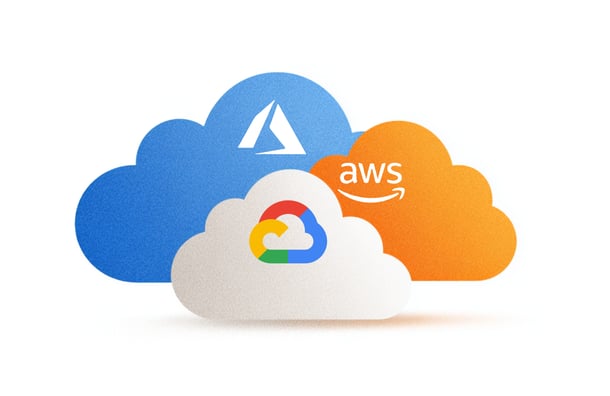
A multicloud strategy brings together cloud computing services from different providers into one architecture. Our work for Amfori shows what such a strategy can look like in practice.
Amfori supports companies in making their supply chain more sustainable. We helped them combine the computing power of Amazon Web Services (AWS) with the powerful analytics of Google Cloud. All centralized within Google’s architecture.
The result for Amfori: a single, centralized solution.
What are the advantages of a multicloud strategy?
Why would your company choose multicloud over single cloud?
Well, there are several advantages. Below are the six main reasons why our customers are switching:
1. The best of all worlds
At first glance, the offerings of the various cloud vendors appear to be fairly similar. But anyone more familiar with these offerings will see clear differences. Each vendor has an area in which it excels:
- timing (availability of features),
- user-friendliness,
- technical depth,
- maturity,
- specific features,
- etc.
A smart multicloud strategy leverages these specific strengths to be as flexible, competitive, and efficient as possible.
2. Improved uptime
By spreading your applications across multiple clouds, you reduce the risk of downtime. If one cloud provider experiences an outage, your activities can seamlessly switch to another.
This ensures business continuity.
3. Multicloud avoids vendor lock-in
With a multicloud strategy, you are not tied to the ecosystem of a single provider.
4. Optimized cost management
Different cloud providers, different pricing models.
With multicloud, you can strategically place your workloads in the most cost-effective environment for that specific task. This allows you to reduce costs.
Research and experience teach us that the price difference in usage between AI language models can be as high as 60%. Relying on a single cloud provider can therefore turn out to be very expensive.

Lead AI Innovation at ACA Group

Research and experience teach us that the price difference in usage between AI language models can be as high as 60%. Relying on a single cloud provider can therefore turn out to be very expensive.

5. Increased flexibility and innovation
Having access to a wider range of services and technologies means you can choose the best tools to drive innovation and respond more quickly to market changes.
6. Better compliance
Some data or applications must comply with specific regulations or are subject to certain geographical restrictions. A multicloud strategy makes it easier to meet these requirements.
A solution we often use is to combine online cloud applications with local (cloud) environments.
Google Cloud Platform: the advantages of GCP 🌟
Multicloud offers many advantages. However, managing different environments can be quite a challenge. Google Cloud makes this a lot easier.
How? With these four advantages:
1. Deeply involved in open-source
Google Cloud has been committed to open-source technologies for years. This facilitates integration with other cloud providers. Tools such as Kubernetes, developed by Google, are fundamental to modern cloud-native architectures and are widely used in all major clouds.
2. Robust network and interconnect options
GCP offers advanced networking capabilities and dedicated interconnects that facilitate secure, high-performance communication between your different cloud environments.
3. Data analysis and AI/ML expertise
Google Cloud is the standard in data analysis and AI/ML. You can use BigQuery, Looker, and Vertex AI to centralize your data from different clouds and make it transparent.
4. Fully secured
With Google's global infrastructure and advanced security features, you can be sure that your multicloud implementations are optimally secured. Thanks to GCP, your data and applications are always protected, wherever they are located.
ACA Group: your partner for Google multicloud? 🤔
With years of experience in AWS, Azure, Google Cloud, and private cloud, we help our customers make the right choices. Because we are not tied to any particular vendor, you can be sure of the best customized solution.
Our team of cloud architects, engineers, and consultants is ready to optimize your cloud and reduce costs.


What others have also read


CloudBrew has always been a highlight on our calendar, but the 2025 edition felt different. Perhaps it was the timing. Just the month prior, November 2025, the Azure Belgium Central region finally opened its doors. ACA has always operated from the heart of Europe, so seeing this massive national milestone go live just before the conference added a layer of excitement.
Read more

In the complex world of modern software development, companies are faced with the challenge of seamlessly integrating diverse applications developed and managed by different teams. An invaluable asset in overcoming this challenge is the Service Mesh. In this blog article, we delve into Istio Service Mesh and explore why investing in a Service Mesh like Istio is a smart move." What is Service Mesh? A service mesh is a software layer responsible for all communication between applications, referred to as services in this context. It introduces new functionalities to manage the interaction between services, such as monitoring, logging, tracing, and traffic control. A service mesh operates independently of the code of each individual service, enabling it to operate across network boundaries and collaborate with various management systems. Thanks to a service mesh, developers can focus on building application features without worrying about the complexity of the underlying communication infrastructure. Istio Service Mesh in Practice Consider managing a large cluster that runs multiple applications developed and maintained by different teams, each with diverse dependencies like ElasticSearch or Kafka. Over time, this results in a complex ecosystem of applications and containers, overseen by various teams. The environment becomes so intricate that administrators find it increasingly difficult to maintain a clear overview. This leads to a series of pertinent questions: What is the architecture like? Which applications interact with each other? How is the traffic managed? Moreover, there are specific challenges that must be addressed for each individual application: Handling login processes Implementing robust security measures Managing network traffic directed towards the application ... A Service Mesh, such as Istio, offers a solution to these challenges. Istio acts as a proxy between the various applications (services) in the cluster, with each request passing through a component of Istio. How Does Istio Service Mesh Work? Istio introduces a sidecar proxy for each service in the microservices ecosystem. This sidecar proxy manages all incoming and outgoing traffic for the service. Additionally, Istio adds components that handle the incoming and outgoing traffic of the cluster. Istio's control plane enables you to define policies for traffic management, security, and monitoring, which are then applied to the added components. For a deeper understanding of Istio Service Mesh functionality, our blog article, "Installing Istio Service Mesh: A Comprehensive Step-by-Step Guide" , provides a detailed, step-by-step explanation of the installation and utilization of Istio. Why Istio Service Mesh? Traffic Management: Istio enables detailed traffic management, allowing developers to easily route, distribute, and control traffic between different versions of their services. Security: Istio provides a robust security layer with features such as traffic encryption using its own certificates, Role-Based Access Control (RBAC), and capabilities for implementing authentication and authorization policies. Observability: Through built-in instrumentation, Istio offers deep observability with tools for monitoring, logging, and distributed tracing. This allows IT teams to analyze the performance of services and quickly detect issues. Simplified Communication: Istio removes the complexity of service communication from application developers, allowing them to focus on building application features. Is Istio Suitable for Your Setup? While the benefits are clear, it is essential to consider whether the additional complexity of Istio aligns with your specific setup. Firstly, a sidecar container is required for each deployed service, potentially leading to undesired memory and CPU overhead. Additionally, your team may lack the specialized knowledge required for Istio. If you are considering the adoption of Istio Service Mesh, seek guidance from specialists with expertise. Feel free to ask our experts for assistance. More Information about Istio Istio Service Mesh is a technological game-changer for IT professionals aiming for advanced control, security, and observability in their microservices architecture. Istio simplifies and secures communication between services, allowing IT teams to focus on building reliable and scalable applications. Need quick answers to all your questions about Istio Service Mesh? Contact our experts
Read more

On December 7 and 8, 2023, several ACA members participated in CloudBrew 2023 , an inspiring two-day conference about Microsoft Azure. In the scenery of the former Lamot brewery, visitors had the opportunity to delve into the latest cloud developments and expand their network. With various tracks and fascinating speakers, CloudBrew offered a wealth of information. The intimate setting allowed participants to make direct contact with both local and international experts. In this article we would like to highlight some of the most inspiring talks from this two-day cloud gathering: Azure Architecture: Choosing wisely Rik Hepworth , Chief Consulting Officer at Black Marble and Microsoft Azure MVP/RD, used a customer example in which .NET developers were responsible for managing the Azure infrastructure. He engaged the audience in an interactive discussion to choose the best technologies. He further emphasized the importance of a balanced approach, combining new knowledge with existing solutions for effective management and development of the architecture. From closed platform to Landing Zone with Azure Policy David de Hoop , Special Agent at Team Rockstars IT, talked about the Azure Enterprise Scale Architecture, a template provided by Microsoft that supports companies in setting up a scalable, secure and manageable cloud infrastructure. The template provides guidance for designing a cloud infrastructure that is customizable to a business's needs. A critical aspect of this architecture is the landing zone, an environment that adheres to design principles and supports all application portfolios. It uses subscriptions to isolate and scale application and platform resources. Azure Policy provides a set of guidelines to open up Azure infrastructure to an enterprise without sacrificing security or management. This gives engineers more freedom in their Azure environment, while security features are automatically enforced at the tenant level and even application-specific settings. This provides a balanced approach to ensure both flexibility and security, without the need for separate tools or technologies. Belgium's biggest Azure mistakes I want you to learn from! During this session, Toon Vanhoutte , Azure Solution Architect and Microsoft Azure MVP, presented the most common errors and human mistakes, based on the experiences of more than 100 Azure engineers. Using valuable practical examples, he not only illustrated the errors themselves, but also offered clear solutions and preventive measures to avoid similar incidents in the future. His valuable insights helped both novice and experienced Azure engineers sharpen their knowledge and optimize their implementations. Protecting critical ICS SCADA infrastructure with Microsoft Defender This presentation by Microsoft MVP/RD, Maarten Goet , focused on the use of Microsoft Defender for ICS SCADA infrastructure in the energy sector. The speaker shared insights on the importance of cybersecurity in this critical sector, and illustrated this with a demo demonstrating the vulnerabilities of such systems. He emphasized the need for proactive security measures and highlighted Microsoft Defender as a powerful tool for protecting ICS SCADA systems. Using Azure Digital Twin in Manufacturing Steven De Lausnay , Specialist Lead Data Architecture and IoT Architect, introduced Azure Digital Twin as an advanced technology to create digital replicas of physical environments. By providing insight into the process behind Azure Digital Twin, he showed how organizations in production environments can leverage this technology. He emphasized the value of Azure Digital Twin for modeling, monitoring and optimizing complex systems. This technology can play a crucial role in improving operational efficiency and making data-driven decisions in various industrial applications. Turning Azure Platform recommendations into gold Magnus Mårtensson , CEO of Loftysoft and Microsoft Azure MVP/RD, had the honor of closing CloudBrew 2023 with a compelling summary of the highlights. With his entertaining presentation he offered valuable reflection on the various themes discussed during the event. It was a perfect ending to an extremely successful conference and gave every participant the desire to immediately put the insights gained into practice. We are already looking forward to CloudBrew 2024! 🚀
Read more